7 Signs You Outgrew WhatsApp Business App
When to leave the free WhatsApp Business App for the API, CRM, and automation—plus a baseline-first decision framework.
· WhatsApp · CRM · Automation · Operations
7 Signs You Outgrew WhatsApp Business App
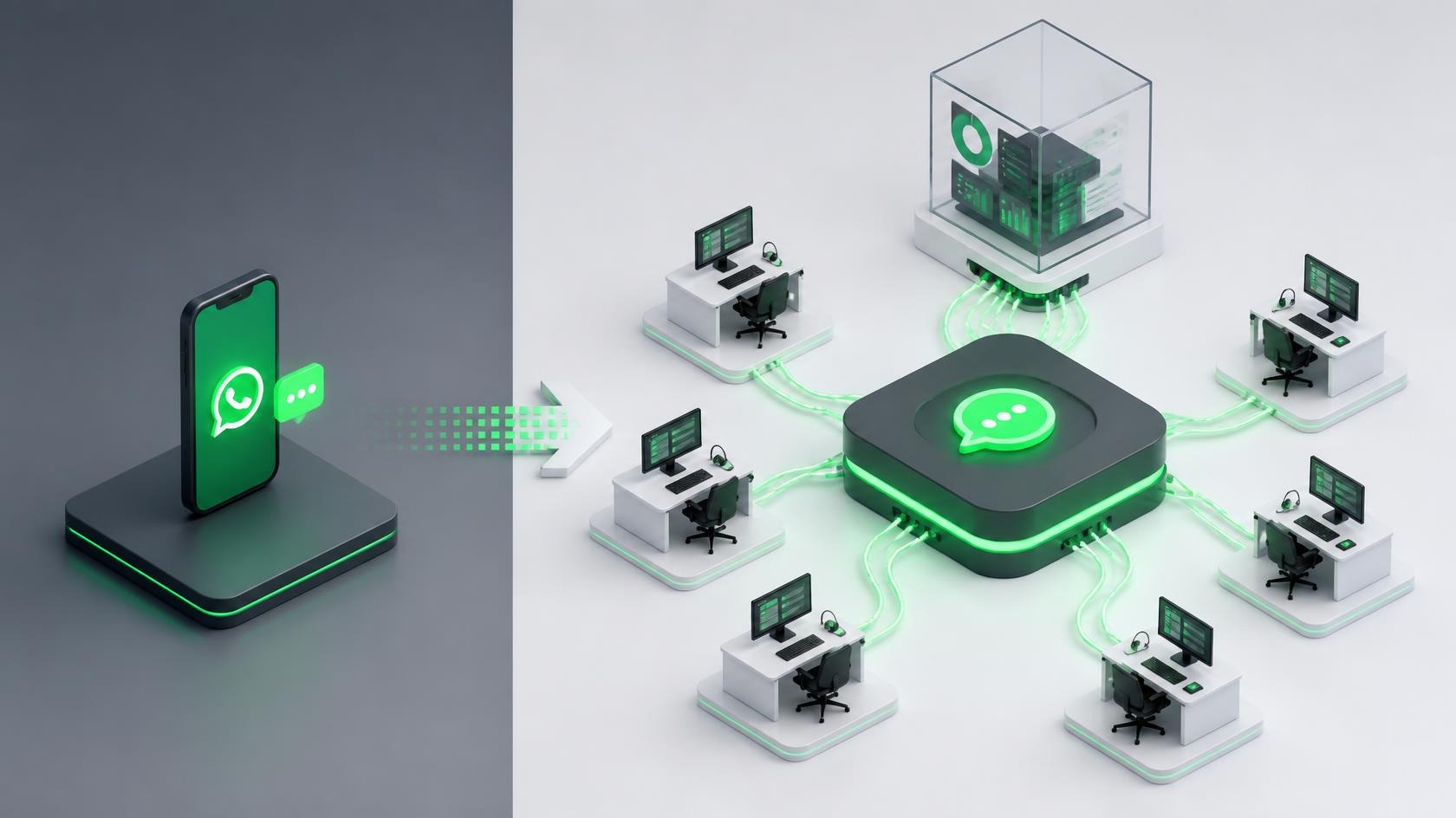
If your team still runs customer conversations on the free WhatsApp Business App, you are not behind—you may simply be at the stage Meta designed that product for. The App is a strong fit for solo operators and very small teams. The WhatsApp Business Platform (often called the WhatsApp Business API) is different infrastructure: multi-agent access, CRM and bot integrations, template broadcasts, and Click-to-WhatsApp ads. This article is an opinion list of seven signs a growing service business—clinics, salons, agencies, multi-branch companies—has outgrown the App and should treat the Platform plus CRM/automation as a strategic operations investment, not a shiny add-on.
TL;DR
- The WhatsApp Business App is free, phone-centric, and built for low-to-moderate volume with limited customization.
- The WhatsApp Business Platform (API) is programmatic access for scale: shared inboxes, bots, CRM sync, templates, and ads—usually via a Business Solution Provider (BSP).
- Upgrade when volume, team size, CRM need, ads, chatbots, or broadcasts create daily friction—not because "everyone uses the API."
- From 1 October 2026, Meta charges for service messages on the Platform after 1,000 free messages per business phone number per month; measure contribution profit, not vanity reply counts.
- Before you build or migrate: capture two weeks of inbound volume, handling time, conversion, and out-of-hours split. That baseline is more valuable than a rushed go-live.
What is the WhatsApp Business App vs the WhatsApp Business Platform?
Definitions (plain language)
WhatsApp Business App
A free mobile app for small businesses to message customers from a single device (with limited linked devices). Meta describes it as free to use, with limited customization and limited integration with other tools. It is designed to help you reach hundreds of customers, not to run a multi-agent operation wired into your CRM.
WhatsApp Business Platform (API)
Programmatic access to WhatsApp for medium and large businesses (and growing small ones that need systems). Meta's own FAQ contrasts it with the App: the Platform lets businesses chat at scale, use rich messaging features, reach far larger audiences, and integrate with the rest of their technology stack. Access is either direct (developer-led Cloud API) or through an approved Business Solution Provider.
CRM / automation layer
The Platform itself is messaging infrastructure. A shared inbox, booking bot, HubSpot/GoHighLevel sync, routing rules, and reporting usually come from your software stack or a partner—not from Meta alone. Treating "API" as a complete product is a common mistake; the investment case is Platform plus the operating system around it.
Service message (pricing term)
A non-template reply sent inside the 24-hour customer service window after a customer messages you. Meta's FAQ states that from 1 October 2026 these are charged per message after the first 1,000 service messages per business phone number each month.
Why this is an operations decision, not a feature chase
Growth creates coordination problems before it creates "missing features." When three people share one phone, when every lead is copy-pasted into a spreadsheet, when ads dump conversations into a channel nobody owns—those are operations failures. The API does not magically fix them. It removes hard constraints of the App so you can design ownership, routing, measurement, and automation.
Vendors will sell you open rates and deflection percentages. A better frame—aligned with serious ROI writing on this topic—is: what would have happened if you did nothing, what costs belong in the denominator, and which outcomes you can observe without inventing client results. That is the lens for the seven signs below.
The 7 signs you have outgrown the WhatsApp Business App
These are decision points, not a checklist you must score perfectly. One hard "yes" can be enough; several soft "yes" answers usually mean you are already paying the App tax in lost context and double work.
Sign 1: More than one person needs governed access to the same number
Is sharing one phone (or WhatsApp Web on one phone) still a workable operating model?
When two or three people need the same customer number with assignment, permissions, and an audit trail, the App's single-device model becomes a bottleneck. The Platform is built for multi-agent access through a shared inbox; the App is not. If you are already rotating a single handset or logging into one Web session, you have outgrown the App's design assumptions.
Ozonetel's 2026 comparison frames the App as one person, one phone, one number, and the API as multi-agent infrastructure. Chattigo's migration guidance makes the same point: App = one device per number; API = omnichannel inbox with many agents in parallel. When "who owns this chat?" is a daily argument, you are past tooling preference into governance.
Opinion: Shared customer channels without assignment rules create silent failure modes—double replies, dropped threads, and no manager visibility. Fixing that with more phones is not a strategy.
Sign 2: Conversation volume exceeds what one focused human can finish well
Are you regularly ending the day with unanswered WhatsApp threads that were still warm at lunch?
Volume alone does not force a migration—but sustained overload does. Ozonetel suggests many businesses feel the break around roughly 100+ daily messages across three or more agents; Chattigo and YCloud emphasize that migration should solve a real constraint (manual work, limited control, missing integration), not vanity scale. Meta's FAQ positions the App for hundreds of customers and the Platform for scale into the millions with stack integration.
Use your own numbers. If first-response time stretches into hours during peak windows, and the only "fix" is asking staff to live inside WhatsApp all day, you are consuming labor that could be structured: triage bots for FAQs, queues for humans, templates for known updates.
Illustrative example (made-up assumptions, not client results): Suppose a salon receives about 80 inbound WhatsApp threads on a busy Saturday, average full handling interruption is 4 minutes, and two staff share one App login. That is over five hours of interrupted attention before any walk-in or phone work. An API inbox with clear ownership does not remove the work; it makes the work assignable and measurable. Label every such calculation as planning math until you have a measured baseline.
Sign 3: You need WhatsApp wired into a CRM or helpdesk—not CSV exports
Do customer chats live only on a phone while your "source of truth" is HubSpot, GoHighLevel, a booking system, or a spreadsheet?
Meta's FAQ is explicit: the Business App offers limited integration; the Platform is meant to connect to the rest of your stack. YCloud's readiness checklist lists CRM, order system, or help desk connection as a migration signal. Ozonetel lists CRM/helpdesk sync as an API capability the App cannot match beyond manual export.
When every closed deal requires someone to retype a phone number into the CRM, you are running two businesses: one that talks, one that records. That gap grows with every hire.
Opinion: CRM need is often the cleanest business case for the Platform. Volume can be managed with discipline for a while; broken context compounds forever.
Sign 4: You want (or already run) Click-to-WhatsApp ads
Are Meta ads meant to open a WhatsApp conversation with attribution and follow-up sequences?
Click-to-WhatsApp (CTWA) ads are a Platform capability in practice. Ozonetel's comparison states CTWA is not available on the App and that ad-triggered conversations can unlock a 72-hour free entry-point messaging window under Meta's rules. Bird's October 2026 pricing notes also emphasize that messages inside an eligible free entry-point window stay free—including service messages—which changes campaign economics when you measure properly.
If your growth plan depends on paid Meta acquisition into WhatsApp, staying on the App means you are planning ads for infrastructure you do not have.
Opinion: Do not buy API "because ads are cool." Buy it when ads are a committed channel and you can measure cost per qualified conversation against contribution—not against open rates.
Sign 5: Repetitive questions and booking steps should be handled by structured flows—not endless typing
Is a large share of daily chats the same FAQ, the same booking form, or the same "are you open / how much / send location" loop?
The App gives quick replies and away messages. The Platform enables bots, Flows, interactive buttons, catalogs, and handoff to humans with context—when you (or a partner) build that layer. Chattigo contrasts App quick answers without business logic against API bots with triage and handoff. YCloud reminds readers that the Platform does not automatically include a chatbot; you still choose software.
This is where product features like an AI receptionist or booking bot belong in the conversation: as features inside systems you deliver or buy, not as mystique. The strategic question is containment of repetitive work with clear escalation—not replacing judgment.
Opinion: Automate the boring middle. Keep humans for exceptions, money decisions, and relationship moments. If you cannot write the escalation rules, you are not ready for a bot—you are ready for a process workshop.
Sign 6: Broadcasts and lifecycle messages outgrew the App's list limits
Do you need opted-in reminders, re-engagement, or segmented updates beyond what broadcast lists on the App allow?
Ozonetel cites a hard App broadcast list cap (256 contacts per list) versus template campaigns on the API for larger opted-in audiences, with compliance and template approval discipline. Template messaging also brings categories (marketing, utility, authentication, service) and market-based pricing—so broadcasts are an ops and finance decision, not only a marketing lever.
If your retention depends on systematic reminders and you are hacking around lists, you have an infrastructure mismatch.
Opinion: Scale without consent and suppression processes is a liability. The Platform makes formal templates and opt-out governance possible; it does not make spam wise.
Sign 7: Managers cannot see first-response time, ownership, or outcomes—only "ticks"
Can leadership answer, this week, who replied late, which location dropped leads, and what share of chats converted?
The App gives delivery/read ticks. The Platform plus inbox/CRM can expose assignment, FRT, conversion tags, and quality sampling—if you instrument them. Chattigo lists reporting (FRT, handling time, conversion by template/flow) as an API-era capability. CodeWords' ROI guidance is sharper still: measure time to first response, conversations closed without a person (counted strictly), enquiries that reach any resolution, and staff interruptions—before inventing revenue fairy tales.
Without visibility, "we reply fast" is folklore. Folklore does not survive a second branch or a second manager.
Opinion: Reporting is not vanity dashboards. It is how you decide whether the Platform investment is paying contribution profit after message costs.
How do the App and Platform differ on Meta's own terms?
What does Meta say is different between the WhatsApp Business App and the Platform?
Meta's FAQ states the App is for small businesses messaging from a single device, free to use, with limited customization and limited tool integration, aimed at hundreds of customers. The Platform enables medium and large businesses to chat at scale with programmatic access, richer messaging features, reach into the millions, and integration with the rest of the technology stack—accessed directly by developers or through partners.
That official split is the foundation. Third-party comparisons (Ozonetel, Chattigo, YCloud) flesh out multi-agent inboxes, bots, CRM, CTWA, and broadcasts. Use Meta for definitions; use operators for migration readiness.
What changed in WhatsApp Platform pricing in October 2026?
Did service messages stay free forever on the WhatsApp Business Platform?
No. Meta's FAQ explains that from 1 October 2026, service messages are charged on a per-message basis. Each business phone number still gets 1,000 free service messages per month; Meta charges from the 1,001st at published rates. Bird's documentation of the same change notes that service messages had been free since November 2024, that the allowance does not roll over, and that messages inside an eligible 72-hour free entry-point window can remain free. Utility template replies inside the customer service window also lost a prior exemption on that date per Bird's summary—verify your market on Meta's current rate card before budgeting.
Why this matters for the upgrade decision:
The free App still has no Meta per-message bill. The Platform now has a clearer variable cost for ordinary replies once you exceed the allowance. That does not mean "stay on the App forever." It means your business case must include message costs, partner fees, build/review time, and escalation labor—CodeWords' denominator list—not only "we'll reply faster."
Opinion: After October 2026, vanity metrics (reply count, open rates) are even less useful. Optimize for contribution: incremental outcomes you can defend, minus full costs.
How should you decide: stay, coexist, or migrate?
A practical decision framework
Answer in order. The first hard "yes" usually ends the debate.
- Volume: Do ordinary weeks overwhelm one focused human without dropping quality?
- Team size: Do two or more people need governed access to the same customer number?
- CRM need: Must chats create or update records in your system of record automatically?
- Ads: Are Click-to-WhatsApp ads live or approved in the next planning cycle?
- Chatbot / flows: Is repetitive work large enough to justify structured automation with escalation?
- Broadcasts: Do lifecycle messages exceed what App lists can responsibly support?
- Visibility: Do managers need assignment, FRT, and outcome reporting—not folklore?
If all answers are "no," stay on the App. If one or two are "yes," pilot Platform capabilities against that constraint. If several are "yes," treat migration as operations modernization.
Ozonetel's published framework is similar (volume, agents, CRM, CTWA, chatbot, broadcasts). YCloud adds a critical caveat: migrate when the App constrains experience and control—not merely because volume rose.
Coexistence (gradual transition)
Several 2025–2026 operator guides describe Meta Coexistence: running App and API on the same number during transition, with caveats about chat history and one-way aspects of moving onto Cloud API. Treat coexistence as a migration tactic, not a permanent architecture. Confirm current Meta rules with your BSP before you plan a cutover weekend.
What baseline should you measure before you build?
What should you measure for two weeks before migrating or automating WhatsApp?
CodeWords' ROI article recommends delaying the build to capture: inbound volume by day and hour; true handling time including interruption; what happens to enquiries (convert, stall, go silent); and the out-of-hours split. Once automation is live, that baseline is gone for good.
This aligns with honest upgrade economics:
- Without a before, every after is a story.
- Without a counterfactual (holdout or careful before/after with limitations stated), "recovered revenue" is often sales that would have happened anyway.
- Costs must sit on the same page as benefits: Meta message charges, BSP fees, model costs if you use generative replies, build time, permanent review sampling, escalation staffing, and the second version you will need after real conversations appear.
Illustrative planning worksheet (assumptions labeled as example only):
| Metric (2 weeks) | Example placeholder | Notes |
|---|---|---|
| Inbound threads / week | e.g. 200 | Count threads, not messages |
| Median first-response time | e.g. 47 minutes | Peak vs off-peak |
| Out-of-hours share | e.g. 28% | Define your hours |
| Converted to booked / paid | e.g. 18% | Your definition of convert |
| Avg handling interruption | e.g. 3–5 minutes | Include context switch |
Replace every "e.g." with your counts. Do not borrow someone else's clinic or salon conversion rate and present it as yours.
How do clinics, salons, agencies, and multi-branch teams hit these signs differently?
Does every service business hit the same upgrade trigger?
No. The signs are shared; the order differs.
- Single-location service businesses often hit Sign 1 and Sign 5 first: one phone, many staff; repetitive booking FAQs.
- Multi-branch companies hit Sign 1 and Sign 7 hard: one brand number vs many; no visibility by location.
- Agencies and professional services hit Sign 3 early: WhatsApp leads never enter the CRM pipeline cleanly.
- Paid-acquisition heavy brands hit Sign 4: CTWA without Platform is a plan on paper.
Clinics are one example in this list—not the only one. The decision is the same class of problem as any growing service operation: channel ownership, system of record, and measured automation.
What does a sensible upgrade path look like?
Steps (operations-first)
- Write the constraint in one sentence. Example: "Three coordinators share one WhatsApp number and we cannot see first-response time by person."
- Run the two-week baseline. Volume, handling time, conversion, out-of-hours.
- Map systems of record. Booking, CRM, payments, identity—what must sync both ways?
- Choose access model. Direct Cloud API (in-house developers) vs BSP/partner (Meta FAQ decision guidance).
- Pick the minimum stack. Shared inbox + templates + CRM sync is often enough for phase one. Bots and ads can be phase two.
- Define escalation and review. Who owns exceptions? What sample of chats is reviewed weekly?
- Pilot with a holdout if you can. CodeWords argues a comparison beats a larger rollout a month earlier.
- Budget the denominator. Message costs after the 1,000 free service messages, partner fees, review time, rebuild.
- Migrate number carefully. Confirm coexistence options, history limits, and that customers keep the same number.
- Re-measure monthly on the same definitions. Report cost per resolved conversation, not only reply volume.
Demos you can inspect (labeled as demos, not case studies):
TeethFlow is Yousuf's own product/case study surface for education and operations—not a source of third-party user counts or revenue claims in this article.
What should you stop claiming in the business case?
Borrowing from CodeWords' "what to stop claiming" list, adapted to this upgrade decision:
- Do not treat channel open rates as outcomes.
- Do not count every bot-touched booking as incremental revenue without a counterfactual.
- Do not borrow deflection rates from another industry blog.
- Do not hide message costs, review time, or escalation load off the page.
- Do not claim compounding "it learns forever" improvement unless someone is deliberately iterating prompts, flows, and policies.
Opinion: A smaller, defensible number beats a large number that collapses in a finance meeting.
What does “contribution profit” mean for WhatsApp operations?
Should you judge WhatsApp success by how many replies you send?
No. After Meta’s October 2026 service-message charging on the Platform, reply volume is partly a cost driver. Contribution thinking asks: what incremental outcomes did the channel create (booked work, retained customers, qualified pipeline), minus the variable costs of messages, tools, review, and escalation—compared with a stated alternative (do nothing, hire another coordinator, stay on the App).
CodeWords separates attributed revenue (a rule that credits a touchpoint) from incremental contribution (outcomes that would not have happened otherwise). Bird’s marketing ROI guidance makes the same distinction in campaign language: attribution is not incrementality. For an App-to-API decision, the “campaign” is the operating model change. If you cannot hold out a group, say so and treat before/after as suggestive, not proof.
Opinion: Finance trusts operators who volunteer the weak assumption. Marketing trusts operators who only show the upside. Pick which meeting you want to win.
A simple contribution sketch (illustrative only)
Assume—for planning, not as anyone’s results—that after migrating to a shared inbox you reduce median first-response time from 90 minutes to 15 minutes during open hours, and that your measured conversion on daytime threads rises from 16% to 19% over eight weeks with seasonality acknowledged. If average contribution per converted job is $80 after variable fulfillment cost (made-up), and you see 10 additional conversions per week that you believe are incremental after a holdout or honesty discount, that is $800/week before message and platform costs. Then subtract Meta charges above the 1,000 free service messages, BSP fees, and one hour/week of review at your true labor cost. If the remainder is still clearly positive, the upgrade is a candidate. If it only works when you pretend every reply creates a sale, it is not.
Replace every assumed percentage with your baseline. The sketch is a teaching tool, not a promise.
Common failure modes after people “upgrade”
Buying the API and keeping App habits
The Platform without assignment rules is just a more expensive chat window. If nobody owns queues, you recreate the shared-phone problem in the cloud.
Automating before policy exists
Bots without escalation criteria create angry customers and silent staff distrust. Write the policy first: what the bot may say, what it must hand off, what it must never invent.
Ignoring quality rating and templates
Template categories, opt-in, and quality affect deliverability and cost. Treat template governance as part of operations, not marketing’s afterthought.
Measuring vanity, starving contribution
Teams celebrate “messages sent” while contribution falls because they blasted marketing templates into cold lists. After October 2026, that habit is more expensive and still ineffective.
Skipping the second version budget
The first inbox or bot design will be wrong in places. CodeWords includes “the second version” in the denominator for a reason. Budget iteration or you will declare failure prematurely—or ship something brittle forever.
How this article differs from “missed appointment” content
This piece deliberately avoids recycling basic no-show tips. The question is infrastructure fit: App versus Platform, plus CRM/automation, under 2026 pricing and measurement discipline. Missed appointments can be one symptom of a broken channel; they are not the decision framework. If your only pain is reminders and one person still owns the phone cleanly, stay on the App and fix process. If your pain is multi-agent chaos, CRM blindness, ads, broadcasts, or unmeasured automation ambition, graduate the channel.
FAQ
Is the WhatsApp Business App still enough for a small team?
Yes—if one or two people can manage volume manually, you do not need CRM sync or ads into WhatsApp, and you accept limited reporting. Meta positions the App for that stage. Leaving early to "look enterprise" wastes money and creates complexity.
When is the WhatsApp Business Platform the right upgrade?
When multi-agent access, CRM/helpdesk integration, bots/flows, template broadcasts, Click-to-WhatsApp ads, or manager visibility are real constraints—not aspirational slides. Ozonetel, Chattigo, and YCloud all frame migration as solving friction, not chasing features.
Does upgrading mean I must build a chatbot on day one?
No. Many teams start with a shared inbox, assignment, templates, and CRM logging. Add structured automation when repetitive volume and clear escalation rules exist. The Platform enables bots; it does not require them on day one.
How does October 2026 pricing change the math?
Service messages on the Platform become chargeable after 1,000 free messages per business phone number per month (Meta FAQ; Bird summary). Budget variable reply costs, keep free entry-point windows in mind for ad-driven chats, and measure contribution profit. The free App still has no Meta message invoice—but it also lacks Platform capabilities.
Can I keep the same phone number?
Operator guides (including migration checklists) generally say customers keep messaging the same number when you move to the Platform; chat history handling depends on coexistence and provider setup. Confirm with your BSP and export anything critical before cutover.
Should I go direct to Meta's Cloud API or use a partner?
Meta's FAQ: in-house developers who can call APIs and webhooks may go direct; teams that need inbox, support software, or bot platforms often prefer an approved partner. Choose based on ownership capacity, not status.
What is the single most valuable step before spending?
Two weeks of baseline measurement: inbound by hour, handling time including interruption, conversion outcomes, out-of-hours split (CodeWords). Delay the build if needed. You cannot reconstruct a clean before after go-live.
How do I talk about ROI without inventing results?
Report observed deltas (FRT, resolution share, interruptions) and state assumptions for any money estimate. Prefer ranges. Keep costs on the same page. Use illustrative math only when labeled as such—never as unnamed "client results."
CTA
If your team is arguing about WhatsApp ownership, CRM gaps, or whether the free App is quietly capping growth, treat it as an operations decision with a baseline—not a weekend plugin install.
- Message Yousuf to walk through your signs and a sober upgrade scope.
- Visit yousufmesalm.com and the demos linked above (WhatsApp CRM, AI automation, GHL, n8n reliability)—labeled demos.
- Ask for the Clinic Lead-Leak Checklist if you want a structured leak map before you buy infrastructure.
Soft package context (only if it fits your stage): WhatsApp booking bot from $399 / ~7 days; WhatsApp + GHL/HubSpot style builds from $599 / ~14 days; fuller automation from $899; care plans $80 / $130 / $200. Scope follows your baseline, not a brochure.
Verified sources
- Meta — WhatsApp for Business FAQ (App vs Platform; Platform pricing including service messages from 1 Oct 2026): https://whatsappbusiness.com/resources/faq/
- Meta — WhatsApp Business Platform product overview: https://whatsappbusiness.com/products/business-platform/
- Meta — Platform pricing overview: https://whatsappbusiness.com/products/platform-pricing/
- Ozonetel — WhatsApp API vs WhatsApp Business App comparison (2026): https://ozonetel.com/whatsapp-api-vs-whatsapp-business-app/
- Chattigo — When to switch from WhatsApp App to API: https://www.chattigo.com/en/blog/When-a-company-needs-to-switch-from-WhatsApp-app-to-WhatsApp-Business-API/
- YCloud — WhatsApp Business App to API readiness checklist: https://www.ycloud.com/blog/whatsapp-business-app-to-api-readiness-checklist
- Bird — WhatsApp October 2026 pricing changes (service messages chargeable; free entry point notes): https://bird.com/docs/knowledge-base/whatsapp/october-2026-pricing-changes
- CodeWords — Measuring WhatsApp automation ROI (baseline, counterfactual, cost denominator): https://www.codewords.ai/blog/roi-of-whatsapp-automation
- Respond.io — WhatsApp pricing help (service message allowance explained): https://respond.io/help/whatsapp/whatsapp-pricing
Note: A "techbloat ROI" URL was considered for this brief; the available TechBloat piece found in search was not a solid 2026 ROI methodology source, so it was not used for claims. Prefer Meta + Bird for pricing and CodeWords for measurement discipline.